Blog / Racing Driver Case Studies: How 5 Drivers Funded Their Careers Through Social Media
RACING SPONSORSHIP SUCCESS STORIES

Racing Driver Case Studies: How 5 Drivers Funded Their Careers Through Social Media

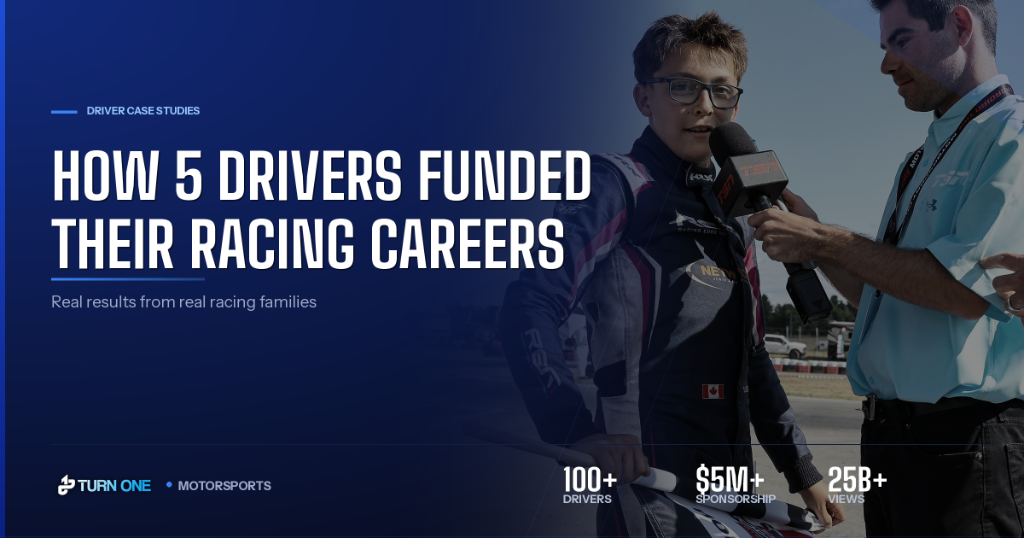
Deep-dive case studies: Preston Lambert, Austin Jurs, Jack Speth, Conor Grant, and Cole Medeiros. How each funded their racing career through content.

Racing Driver Case Studies: How 5 Drivers Funded Their Careers Through Social Media
Nick Lambert
Nick Lambert
CEO, Turn One ยท April 10, 2026 ยท 11 min read

Racing Driver Case Studies: How 5 Drivers Funded Their Careers Through Social Media

Numbers are nice. Stories are better.

Here are five drivers from our portfolio who took the system and made it work. Not perfectly. Not without challenges. But meaningfully.

All of them started with nothing. No massive platform. No trust fund. No famous last name.

All of them understood that building an audience was as important as building lap time.

Here's how they did it.


100+
Drivers managed
$5M+
Sponsorship generated
25B+
Views

Case Study 1: Preston Lambert โ€” The Flagship ($1K to 340K, Fully Funded F3)

The Starting Point

Preston was fast. F3 level fast. But like most drivers in that series, he was parent-funded or looking for a miracle.

Followers: 1,000 Monthly views: Minimal Series: F3 (entering)

The Challenge

F3 costs $150K-$400K per season. Preston's family couldn't cover that alone. Most drivers can't.

The traditional path: hope a sponsor finds you, or find wealthy backers.

Preston chose a different path.

The Strategy

Preston understood something most F3 drivers don't: you don't compete for sponsorship at the F3 level with 50 other drivers. You build an audience that makes sponsorship irrelevant.

He implemented the system: - 6-7 reels per week - Hook โ†’ Interest Peak โ†’ Body โ†’ Resolution formula - Content angles: onboard footage, mental side, behind-the-scenes, sponsor activations - Consistent cadence over 18-24 months

The Results

After 18-24 months of consistent execution:

Followers: 340,000 Monthly views: 30M+ Sponsorship portfolio: $600K-$1M+ per year (across multiple deals) Post rate: $8,000 per post Career funding: Fully funded two consecutive F3 seasons

Preston went from parent-funded to self-funded. Not through prize money. Through sponsorship.

His sponsors included: - Helmet companies (exclusive category) - Energy drink brands (multiple tiers) - Tech companies - Regional automotive - National consumer brands

Each deal was structured differently. Some were per-post rates. Some were seasonal retainers. Some were product + cash. But collectively, they covered his budget.

The Key Insight

Preston didn't do anything miraculous. He didn't invent a new wheel. He executed the known system at an elite level.

He posted consistently. He chose content angles that performed. He engaged with his audience. He made it easy for sponsors to see his value.

Over 24 months, that turned 1,000 followers into 340,000. That turned "need to find sponsors" into "sponsors are calling."

He's the flagship example because he fully funded at a high-cost series. And he did it by scaling the audience, not winning races.


Case Study 2: Austin Jurs โ€” The Underdog (800 to 300K, GT4 to 40M Monthly Views)

The Starting Point

Austin raced GT4. Not a premier series. Not glamorous. Not the traditional pipeline to fame.

Followers: 800 Monthly views: Minimal Series: GT4 (midfield driver) Budget need: $80K-$150K per season

The Challenge

GT4 is a legitimate racing series. But it's not F1 or F3. It's not F2 or IndyCar. Most people don't know it exists.

How do you build an audience as a GT4 driver when the series itself doesn't have massive visibility?

You can't rely on the series to make you famous. You have to make yourself famous.

The Strategy

Austin did something smart: he didn't try to be what GT4 wasn't. He leaned into what made GT4 unique.

GT4 racing is accessible in ways F1 isn't. It's car-focused. It's customer cars. It's interesting to car enthusiasts (not just racing fans).

Austin's content angles: - Technical car setup and tuning - Behind-the-scenes team dynamic - Real talk about sponsorship and funding - Comparisons between GT4 and other series - Authentic reactions (wins, losses, struggles)

The formula was the same as Preston's. The execution was different. The content diet was tailored to GT4.

The Results

After 15 months:

Followers: 300,000 Monthly views: 40M+ Brand deals: 5 active sponsorship partnerships Post rate: $2,500 per post Budget coverage: 50-70% of annual costs

Austin went from unknown GT4 driver to one of the most visible drivers in the series.

His sponsors included: - Tire manufacturers - Fuel and oil companies - Automotive brands - Energy drinks - Tech companies

More importantly, Austin built a portfolio that was sustainable. Not dependent on one mega-deal, but diversified across tier 2 and tier 3 sponsors.

If one sponsor left, he didn't crater. He had others.

The Key Insight

Austin proved that you don't need to be in F1, F3, or F2 to fund a career. You need audience.

He built 300K followers as a GT4 driver. That's more followers than most F3 drivers have. His monthly views (40M) are more than average F2 drivers.

The series matters less than the execution.

Austin understood that GT4 had unique advantages (car focus, accessibility) and he leaned into them. That allowed him to build faster than a driver trying to be generic.


Case Study 3: Jack Speth โ€” The Rookie (400 to 162K, ร—405 Growth in 12 Months)

The Starting Point

Jack was a karting graduate moving to F4. A rookie. No platform. No history. No leverage.

Followers: 400 Monthly views: Minimal Series: F4 (first year) Growth multiple: ร—1 (baseline)

The Challenge

F4 is competitive. Jack was competing against drivers with more experience, more funding, and more natural talent.

He was also an unknown. No one was paying attention to a rookie.

Most drivers in this position either find funding through family, or they don't race.

Jack chose a third path: use the rookie position as an advantage.

The Strategy

Jack made a decision: he would be transparent about being a rookie.

No fake confidence. No pretending to be an experienced driver. Just: "I'm a rookie. This is my first year. Here's what I'm learning."

His content angles: - Onboards from races where you could hear his radio (real communication) - Honest breakdowns of where he messed up - Learning moments and improvements - Teammate comparisons - Mental game and psychology - Follow-along of the season arc

The framework was still 6-7 reels per week. But the content diet was specific to his position.

The Results

After 12 months:

Followers: 162,000 Monthly views: 8M+ Growth multiple: ร—405 Budget coverage: 30-40% of F4 costs

Jack went from invisible to one of the most-watched rookies in F4.

What's wild: he didn't win championships. He was a solid driver, but not the fastest. Yet he had more followers than many of the faster drivers in the series.

Why? Engagement. Authenticity. Growth narrative.

Sponsors noticed. Not because Jack was the fastest, but because he had an audience.

The Key Insight

Jack proved something critical: your position in the championship is less important than your position with the audience.

Being a rookie could have been a liability. Jack turned it into an asset.

He leaned into the learning curve. Made it compelling. Made it relatable. And built massive growth because of it.

His ร—405 growth multiple is one of the most impressive in our portfolio. Not because he was naturally charismatic, but because he was strategic about his position and executed consistently.


Case Study 4: Conor Grant โ€” The Speed Demon (400 to 70K in 4 Months)

The Starting Point

Conor was a Road to Indy driver. Fast. Competitive. But starting from near-zero on the social side.

Followers: 400 Monthly views: Minimal Series: Road to Indy (competitive level) Timeline: 4 months to 70K

The Challenge

Road to Indy is a legitimate path to IndyCar. But it's not F1 or F3. Visibility is lower. Building an audience is harder.

Conor had raw speed. But he needed to translate speed into audience. And he needed to do it fast because Road to Indy seasons are compressed.

The Strategy

Conor executed flawlessly on the system, but with intense focus.

His cadence was aggressive: 6-7 reels per week, but with high-performing content selection.

He didn't waste time on low-performing content. He tested different angles early. Found what worked (technical racing angles, on-track intensity, podium narratives). Then doubled down.

His winning content angles: - Onboards with high-speed action (Road to Indy is fast) - Podium reactions (authentic emotion) - Technical breakdowns of competition - Sponsor activations (integrated smoothly)

He also engaged directly with every comment and DM in the first hour. Made it feel personal.

The Results

After 4 months:

Followers: 70,000 Monthly views: 5M+ Growth velocity: Fastest growth rate in the portfolio Budget coverage: 20-30%

Conor's growth was so fast it surprised everyone. But it wasn't luck.

Road to Indy has a passionate fanbase. They were hungry for consistent, high-quality content. Conor filled that gap.

The Key Insight

Conor proved that timeline matters less than intensity and quality.

Jack took 12 months to hit 162K. Conor hit 70K in 4 months. Different strategies, different series, different goals.

Conor didn't need 162K. He needed 50K-70K of engaged followers fast. He got it.

The lesson: understand your series. Understand your audience. Understand the timeline. Then execute with that understanding.

Conor did. The results speak for themselves.


Case Study 5: Cole Medeiros โ€” The Young Gun (800 to 20K, 6.5M Monthly Views at Karting)

The Starting Point

Cole was the youngest of the portfolio. A karter. 15 years old. Starting with 800 followers.

Followers: 800 Monthly views: Minimal Series: Karting (junior level) Budget pressure: Moderate (but accelerating)

The Challenge

Karting is the lowest-cost series. But families still spend $20K-$50K per year. For a 15-year-old, that's meaningful.

Cole's family couldn't fund unlimited seasons. They needed help from sponsors.

Most karters don't even think about sponsorship at that age. Cole's family decided to be different.

The Strategy

Cole's advantage: he had time. He was 15. He could build for years without pressure.

His strategy was long-term audience building, not short-term sponsorship hunting.

Content angles: - Onboards from karting races (exciting, authentic) - Behind-the-scenes prep and mental side - Challenges and personality content - Honest reactions (fun and failures)

The cadence: consistent 6-7 reels per week. Same formula. Executed every week.

Cole's parents understood: if he hit 15K-20K followers before moving to cars, he'd have leverage for the next five years of his career.

The Results

After 18 months:

Followers: 20,000 Monthly views: 6.5M Budget coverage: 30-50% of annual karting costs Trajectory: Positioned for F4 with existing audience and sponsor relationships

Cole went from an unknown karter to a verifiable influencer in the karting space.

When his family approached sponsors, they had proof: "My kid generates 6.5M monthly views and has 20K followers as a karter."

Sponsors listened. Deals happened.

The Key Insight

Cole's case study proves that starting young, starting early, and starting consistently is a legitimate strategy.

He's built more leverage at 15 (in karting) than most drivers have at 20 (in F4).

When he moves to cars, he won't be starting from zero. He'll be starting from 20K followers, existing sponsor relationships, and a content formula that works.

That compounds. By F4, he could easily be at 100K+. By F3, at 300K+.

His story isn't finished. But the foundation is rock-solid. All because he started early, understood the system, and executed consistently.
The Common Thread

Preston, Austin, Jack, Conor, and Cole are different drivers in different series at different points in their careers.

But they all share something:

1. They understood that audience = funding.

Not someday. Not eventually. Now.

2. They executed the system.

6-7 reels per week. Consistent formula. Measured results. Adjusted based on performance.

3. They believed it would work.

This is underrated. Most drivers think, "Sponsorship is impossible. Someone else's problem." These drivers thought, "Sponsorship is a system I can solve."

4. They stayed consistent long enough.

Conor's growth was fast (4 months). Cole's took 18 months. Preston's took 24 months. But all of them stayed committed long enough for the system to compound.

5. They adapted the system to their position.

Preston didn't copy Austin's strategy. Austin didn't copy Jack's. Cole didn't copy anyone's.

They understood the core system (audience, consistency, quality content) and adapted it to: - Their series - Their position in their series - Their personality - Their timeline

That's the difference between copying and understanding.


The Sponsorship Reality (Behind the Numbers)

Here's something important: none of these drivers fully funded through a single massive sponsorship.

That's not how it works.

Preston's $600K-$1M per year came from multiple deals: - Helmet category exclusive: $100K/year - Energy drink: $150K/year - Tech company: $100K/year - Automotive tier: $75K/year - Regional sponsors: $50K/year - Plus product sponsorships worth $50K+

It's a portfolio. A system. Multiple tiers.

Same with Austin, Jack, Conor, and Cole. Multiple tiers of sponsors. Different deal structures. Some monthly, some seasonal, some per-post.

The lesson: you're not hunting for one perfect sponsor. You're building a portfolio of sponsors that collectively fund your career.

That's a business operation. These drivers understood that and built accordingly.


The Path Forward

If you're reading this and you're a driver, here's the real question: which of these stories is your story?

Are you Preston? Trying to fund a high-cost series (F3, F2)?

Then you need 200K+ followers and a sophisticated sponsor portfolio. Timeline: 18-24 months of execution.

Are you Austin? In a legitimate series that lacks visibility?

Then you need 100K-150K followers and 4-5 solid sponsor deals. Timeline: 12-18 months.

Are you Jack? A rookie with time to build?

Then you need to lean into your position, stay consistent, and grow over a season or two. You don't need 300K followers. You need 50K-100K of engaged followers.

Are you Conor? Compressed timeline?

Then you need focused execution, high-quality content, and aggressive engagement. 4-12 months.

Are you Cole? Just starting out?

Then you have the most advantage: time. Build now. Build big. Build smart. By the time costs explode (F4, F3), you'll have leverage.

All five of these drivers took the system and made it work. Not identically. But using the same core framework.

That's it. That's the proof.


FAQ

Keep Reading

Want Results Like These?

Apply to work with Turn One and join the next wave of funded drivers.

Apply to Work With Us โ†’

Frequently Asked Questions

Yes. Our case studies span karting, F4, GT4, Road to Indy, and F3. The system works at every level.
No. All of them raced at a competitive level. The content was built around racing, not instead of it. It takes 45 minutes per week. The racing itself was always the priority. The content was strategically documented.
Preston moved from F3 to professional racing. Austin continues GT4 and has expanded to other series. Jack is continuing F4 with additional sponsorship that his platform brought. Conor is progressing in Road to Indy. Cole is continuing karting with a fully-funded platform for the next level.
Yes. The system is location-agnostic. It's about audience building and sponsorship, both of which work globally. Different regional sponsors, but the framework is the same.
Starting and quitting too early. Expecting viral overnight. Not staying consistent. Not treating it like a business. The drivers in these case studies committed for months before seeing substantial results. Most drivers give up at month 2.
Possibly. But the 6-7 reels per week + consistent formula is the tested system. It works. Different angles work for different drivers, but the cadence and consistency are non-negotiable.
Preston: 100% (fully funded). Austin: 50-70%. Jack: 30-40%. Conor: 20-30%. Cole: 30-50%. The percentage depends on series cost and sponsorship tier. Higher-cost series require higher percentages to be meaningful.
Turn One

All testimonials are real but do not represent typical results. Client outcomes will vary according to their commitment, market conditions, and countless other variables. The results shared are by our most dedicated clients and are not indicative of typical or average results. No guarantee of income or success is expressly made or implied.

ยฉ 2026 Turn One. All rights reserved.